


You must prove financial capacity to get an Australian Subclass 500 student visa, and that means evidencing four money components at once: the Department of Home Affairs’ 12-month living-cost benchmark, your first-year tuition, travel costs, and any family add-ons if a partner or children are coming with you. Meeting that number on paper is only half the job. You also have to show the funds are genuinely yours to access, not a balance that appeared the week before you applied. Officers can and do request follow-up verification, so treat every figure as something you need to defend, not just declare.
Before you gather a single document, confirm the current numbers directly against the primary sources: the Migration (LIN 19/198) Instrument, the Department of Home Affairs student visa page, and Study Australia. Here’s what you’re actually building evidence around:
- The 12-month living-cost benchmark set for a single applicant
- First-year course fees as invoiced by your institution
- Return travel costs to and from Australia
- Partner and dependent-child costs, including school fees where relevant
Key Takeaways
Meeting the student visa financial capacity requirement means proving both the right dollar amount and a genuine, documented source for every dollar of it.
| Point | Details |
|---|---|
| Know the four components | Budget for the 12-month living-cost benchmark, first-year tuition, travel, and family add-ons together, not separately. |
| Match evidence to accepted categories | Use bank deposits, regulated loans, government loans, or scholarship letters exactly as the Migration Instrument defines them. |
| Document the source of large deposits | Attach sale agreements, loan contracts, or employer letters to explain any unusual account activity. |
| Budget above the legal floor | Add real tuition, travel, and city-specific living costs on top of the AUD $29,710 benchmark. |
| Get financial evidence reviewed early | Fewa’s MARA-registered consultants can check your documents against current requirements before you lodge. |
This article is general information, not a substitute for advice from a qualified lawyer. Consult a qualified legal professional about your own circumstances before acting on anything here.
Table of Contents
- What Evidence of Financial Capacity Does the Department Accept?
- How Much Money Do You Need to Show for an Australian Student Visa?
- What Do Officers Look for to Confirm Genuine Access to Funds?
- Budgeting Beyond the Visa Floor: Fees, Travel, and City Living Costs
- What Financial Evidence Mistakes Trigger Delays or Refusals?
- What the Financial Capacity Rules Really Test
- How Fewa Helps You Build a Stronger Financial Evidence File
- Sources
What Evidence of Financial Capacity Does the Department Accept?
The Department doesn’t ask you to guess what counts as proof. The Migration Instrument sets out the accepted categories directly, and your job is to match your paperwork to one of them cleanly.
- Bank deposits with a financial institution — recent statements (typically covering several months) showing consistent balances, not a single snapshot.
- Loans from a financial institution — a signed loan contract from a regulated bank or lender, including the approved amount and disbursement terms.
- Government loans — official loan approval letters from a government lending body in your home country.
- Scholarships or sponsorships — an award letter on official letterhead confirming amount, duration, and what it covers.
- Supporting income documents — payslips, employer letters, and tax returns when a parent or spouse’s income backs the application.
Officers look past the number itself. They check recentness (statements too old raise questions), consistency (an account history with no sudden spikes), and authenticity markers like official letterheads and verifiable lender details. A loan contract missing a regulator’s name or an account statement with a single deposit dated days before lodgement invites a request for more evidence.
Pro Tip: Request bank statements directly from your institution rather than downloading a PDF from your banking app. Officers view stamped, bank-issued statements as more credible than self-generated printouts.
How Much Money Do You Need to Show for an Australian Student Visa?
Study Australia states that a single primary applicant must show proof of at least AUD $29,710 as the 12-month living-cost benchmark. That figure sits on top of, not instead of, your other obligations.
The full stack looks like this:
- 12-month living-cost benchmark: AUD $29,710 for the primary applicant
- First-year course fees: the amount your institution has invoiced you for the first year of study
- Travel costs: return airfare, priced realistically for your route
- Partner traveling with you: an additional amount set by the Migration Instrument
- Each dependent child: a further amount, plus school fees if the child will attend an Australian school
A family of three (student, partner, one child) is showing a materially larger total than a single applicant once you stack the partner and child components onto the base benchmark and tuition. The Department and the Migration Instrument set these figures, not any guide or agent, so treat the legislation and the Department’s own page as your final word before you lodge. Numbers get adjusted periodically, and quoting an outdated figure in your application is an easy, avoidable error.
What Do Officers Look for to Confirm Genuine Access to Funds?
A bank balance that meets the threshold doesn’t automatically satisfy an officer. What matters more is whether the money looks like it has always belonged to you, or whether it looks like it was moved into place for the application. Migration practice consistently flags sudden large deposits and informal family transfers as the two most common triggers for extra scrutiny, because both can signal borrowed or temporary funds rather than genuinely available capacity.
If a deposit has an unusual source, document that source. A property sale needs the sale agreement. A private loan needs a signed contract, and ideally one from a regulated lender rather than a handshake agreement with a relative.
Build your evidence package around these pillars:
- Multi-month bank statements showing steady, unremarkable balances over time
- Loan contracts from regulated financial institutions, not informal or undocumented arrangements
- Official scholarship or sponsorship letters with clear terms
- Payslips and tax records if you’re relying on a parent or partner’s income
Using a parent or spouse’s income as your funding route is entirely valid, but it tends to draw closer review. Supply several months of payslips alongside official tax notices, since a single payslip rarely satisfies an officer on its own.
Pro Tip: If your funds come from a family member other than a parent or spouse, prepare a written explanation of the relationship and the reason for the transfer. Officers are far more comfortable with money whose story is documented than money that simply appears.
Budgeting Beyond the Visa Floor: Fees, Travel, and City Living Costs
The Department’s benchmark is a legal minimum, not a real-world budget. Study Australia is explicit that the benchmark can understate what you’ll actually spend, particularly in Australia’s more expensive cities, so treat it as a floor rather than a target.
Here’s a practical way to build a realistic figure:
- Start with the AUD $29,710 living-cost benchmark as your base.
- Add your invoiced first-year tuition exactly as billed by your institution.
- Add a realistic return airfare, priced for your actual departure city.
- Research rent, transport, utilities, and food costs for the specific city you’re moving to, since Sydney and Melbourne carry noticeably higher rent than many regional centers.
- Build in a buffer above the benchmark if you’re heading to a high-cost city, since visa approval doesn’t guarantee your funds will comfortably cover twelve months of living there.
Fewa’s guide to Australian student visa costs breaks down how the visa benchmark compares with real living costs city by city, which is worth checking before you finalize your budget.
What Financial Evidence Mistakes Trigger Delays or Refusals?
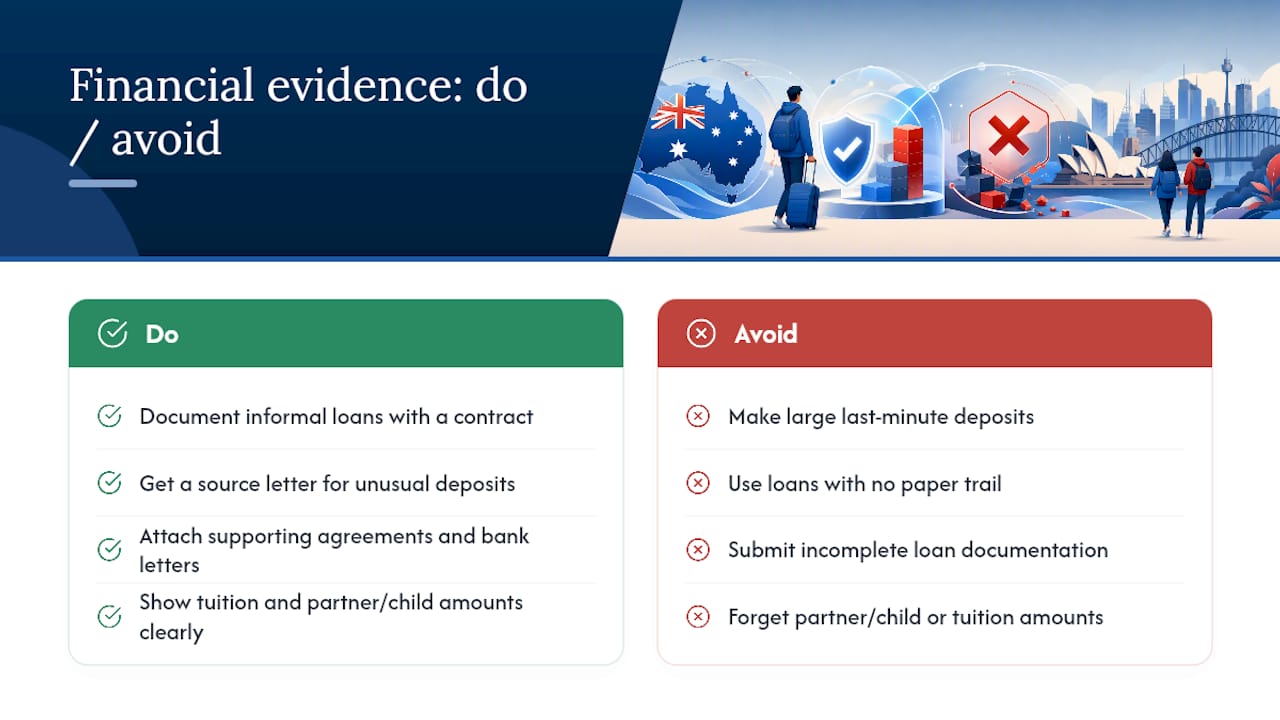
The most frequent errors are avoidable once you know what officers are trained to notice. Last-minute deposits sit at the top of the list, followed by informal loans with no paper trail, incomplete loan documentation, failing to show tuition is actually covered, and forgetting to add partner or child amounts entirely.
Each of these tends to produce one of three outcomes: a request for further evidence, a processing delay while you scramble for documents, or, in the worst case, a refusal. The fix for most of them is straightforward if you catch it early. Converting an informal loan into a properly documented contract, or obtaining a source letter for an unusual deposit, can resolve what would otherwise look like a red flag.
Consider a family that transferred a large sum from a home sale into the applicant’s account two weeks before lodgement. On its own, that deposit looked exactly like the kind of last-minute inflation officers are trained to question. Attaching the signed property sale agreement and a bank letter confirming the transfer’s origin turned an ambiguous transaction into a documented, defensible one.
What the Financial Capacity Rules Really Test
The conventional advice on this topic stops at the dollar figure, and that’s where most applicants get a false sense of security. Hitting AUD $29,710 plus tuition and travel is table stakes. It tells an officer nothing about whether the money is real, stable, or actually available to you in twelve months.
What the evidence actually needs to do is tell a coherent financial story: where the money came from, how long it’s been there, and why it makes sense for your family to have it. A loan from a cousin with no paperwork and a loan from a regulated bank can be the same dollar amount and receive completely different treatment, because one has a verifiable source and one doesn’t.
If you’re prioritizing anything first, prioritize your bank account history over your final balance. A consistent six-month history with modest, explainable movements will do more for your application than a balance that spiked right before you applied. The number gets you in the door. The paper trail behind it is what gets you through.
— Ronit
How Fewa Helps You Build a Stronger Financial Evidence File
Meeting the financial capacity test on paper and meeting it in a way that survives officer scrutiny are two different challenges, and most refusals happen in the gap between them. Fewa Education & Migration is a MARA-registered consultancy that works through that gap directly with applicants, reviewing bank statements, loan contracts, and sponsorship letters before lodgement rather than after a request for further evidence arrives.
The team helps you build a document checklist specific to your funding route, whether that’s savings, a bank loan, or a parent’s income, and liaises with your education provider to confirm exact first-year fees so your figures match what the Department expects to see. If your evidence has gaps, correcting them before lodgement is far less costly than correcting them after a refusal. Visit Fewa’s student visa services page or book a free initial consultation to have your financial documents reviewed before you submit.
Sources
- Migration (LIN 19/198: Evidence of financial capacity – Subclass 500 Visa and Subclass 590 Visa) Instrument 2019 (compilation)
- How to apply for your visa | Study Australia
- Student visa (subclass 500) | Department of Home Affairs