


The China X2 visa is the short-term student visa for study visits of no more than 180 days, and it’s the category most Australians heading to China for a short course, exchange semester, or research stint will need. You apply through the Chinese Embassy, a Consulate-General, or the Chinese Visa Application Service Center (CVASC) covering your part of Australia, and if your program runs long, limited extensions are possible once you’re already in China.
TL;DR:
- Australian applicants must have a confirmed admission notice and a course duration of 180 days or less to qualify for the X2 visa.
- Complete online application, gather all original documents, and apply in person at the correct consulate or CVASC in Australia.
- Processing times vary by location and season, and fees depend on passport type and processing speed, so check current details early.
- Once in China, X2 visa holders generally do not need a residence permit unless their stay exceeds the stamped duration.
- Common application errors include invalid passports, incorrect photos, missing translations, and document organization, which can lead to delays or rejections.
Table of Contents
- What Does the China X2 Visa Cover, and How Is It Different From X1?
- Who Should Apply for X2 From Australia?
- What Documents Do You Need for an X2 Application?
- How Do Australians Actually Submit an X2 Application?
- How Long Does Processing Take, and What Does It Cost?
- What Do You Need to Do Once You Arrive in China?
- What Mistakes Do Applicants Make Most Often?
- Fewa’s Practical Perspective on Helping Australians With X2 Applications
- Let Fewa Handle the Details of Your China X2 Application
- Sources
What Does the China X2 Visa Cover, and How Is It Different From X1?
The X2 visa is built for study that wraps up in 180 days or less. Think short courses, semester exchanges, language immersion programs, brief research placements, or a family member accompanying a student for a short academic stint. If your course or contract at a Chinese institution runs longer than six months, you need the X1 visa instead. X1 carries an obligation X2 does not: holders must apply for a temporary residence permit within 30 days of entry. That single distinction, residence permit or no residence permit, is often the fastest way to tell which category actually fits your plans. If you’re weighing a longer program, our breakdown of how to apply for a student visa in China walks through the X1 process in full.
Who Should Apply for X2 From Australia?
Before you touch the application form, confirm you have an Admission Notice or equivalent invitation letter from a Chinese institution. Without it, there’s no application to submit. Beyond that, a handful of eligibility checks decide whether X2 is genuinely your lane:
- Passport validity: your passport needs to have sufficient validity as required by the consulate, plus a blank visa page.
- Course length: if the institution confirms your program is 180 days or shorter, X2 is correct; anything longer points to X1.
- Application location: Australian citizens and permanent residents generally apply from Australia, but if you’re applying from a third country, you’ll usually need proof of legal residency there, not just a tourist stay.
- Purpose match: a family member joining a student for a short visit, rather than studying themselves, may fit better under a visitor visa than X2. If your trip is genuinely tourism or family visiting with no enrollment involved, check our guide on the China family visa options before defaulting to a student category.
Getting this call right upfront saves you from a rejected application later, since consulates check purpose-of-visit against document type closely.
What Documents Do You Need for an X2 Application?
Assemble these before booking your appointment, since incomplete files are the single biggest reason submissions get bounced back:
- Valid passport (original plus a photocopy of the bio page) with at least six months’ validity remaining
- Completed and signed visa application form, printed from the relevant consulate or CVASC portal
- One recent color photo meeting the specified dimensions, typically 48mm by 33mm with strict head-size and background rules
- Admission Notice or Admission Letter from your Chinese institution, plus DQ or JW forms if your school issues them
- Proof of legal stay in Australia if you’re not an Australian citizen or permanent resident applying from home
- Certified translations of any non-English or non-Chinese supporting documents
- Copies of any previous Chinese visas in your passport history
- Any institution-specific cover letters confirming enrollment dates or program length
Pro Tip: Photocopy your entire document set twice before your appointment. One set stays with the consulate, one travels with you as backup, and you’ll thank yourself if anything gets misplaced at the counter.
How Do Australians Actually Submit an X2 Application?
Chinese visa processing runs on a two-stage system almost everywhere: an online review first, followed by offline submission of your original documents in person. Skipping straight to a physical visit without completing the online step usually gets you turned away.
- Complete the online application form and upload scanned documents through the relevant consulate or CVASC portal.
- Wait for online review confirmation before booking an in-person appointment.
- Attend your appointment with all original documents plus copies, in the order listed on your cover sheet.
- Submit your passport and paperwork for verification; some applicants are asked follow-up questions on the spot.
- Collect your receipt and confirm the expected collection date for your passport.
A few practical notes worth knowing before you go:
- Australia’s Chinese consulates and the CVASC network almost never accept mailed applications; in-person submission is the norm.
- Jurisdiction matters. Sydney, Melbourne, Brisbane, Perth, and Canberra each fall under a specific consulate or CVASC office, so check which one covers your address before booking.
- Bring a second form of ID in case the counter officer asks for it during verification.
- Some offices retain your passport until visa issuance, so plan travel dates with that turnaround in mind.
If you’re new to the broader process, our overview of how to apply for a student visa in Australia covers the parallel steps for the reverse journey, which can help you understand what Chinese authorities expect in return.
How Long Does Processing Take, and What Does It Cost?
Processing windows vary by consulate, by season, and by how complete your file is on submission day. Peak periods around semester starts tend to run slower, so applying early gives you a buffer. Rather than quoting a fixed number here, check current processing times for your specific jurisdiction, since timing shifts throughout the year.
Fees are published directly by each consulate and the CVASC network, and they can differ depending on your passport type and processing speed selected. Confirm the exact fee on the official page for your jurisdiction before you pay anything to a third party claiming to quote you a fixed rate.
If your course runs longer than expected once you’re already in China, you have two paths:
- Extension: apply at your local Exit and Entry Administration office at least 30 days before your visa expires. Cumulative extension limits apply, so this isn’t unlimited.
- Change of visa type: if your program has genuinely shifted from short-term to long-term study, you may need to convert to X1, which typically requires updated enrollment documentation from your institution.
What Do You Need to Do Once You Arrive in China?
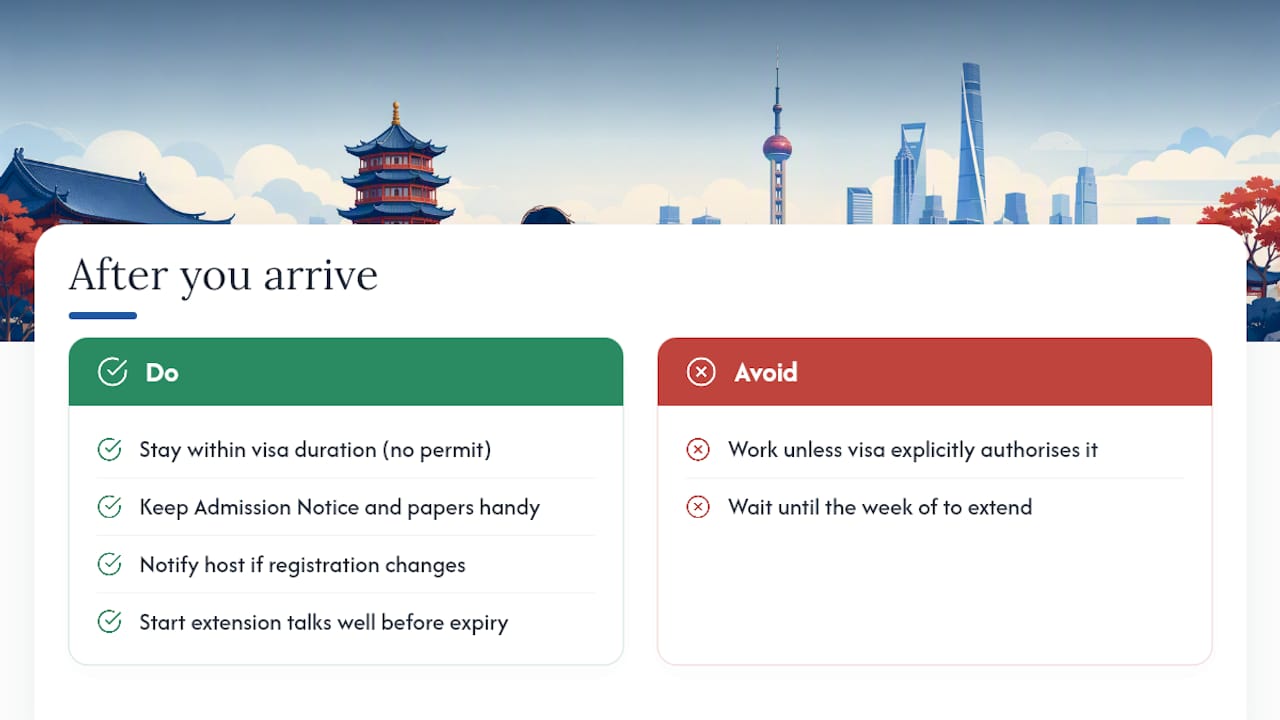
X2 holders generally don’t need to apply for a temporary residence permit as long as they stay within the duration stamped on their visa. That’s a relief compared to X1, but it doesn’t mean you’re free of obligations.
Employment is off the table unless your visa explicitly authorizes it. Don’t assume a short-term study visa lets you pick up paid work on the side. Keep your Admission Notice and enrollment paperwork accessible throughout your stay, and notify your host institution promptly if your registration details change. If your program looks like it’ll run past your visa’s expiry, start the extension conversation with your local Exit and Entry Administration office well before the deadline, not the week of.
What Mistakes Do Applicants Make Most Often?
A surprising number of X2 applications stall over avoidable errors. Photos that don’t match the exact size specification, passports with less than six months’ validity, and missing translations account for a large share of rejections and resubmissions.
- Double-check your photo against the official specification before printing.
- Confirm which CVASC or consulate covers your jurisdiction, and verify they don’t accept mailed applications.
- Organize originals and copies in one clear sequence before your appointment.
- If your enrollment date shifted, get a formal extension letter from your institution rather than hoping the discrepancy goes unnoticed.
Pro Tip: Build a one-page cover sheet listing every document in the order you’re presenting them. Counter officers move faster through organized files, and it cuts down on back-and-forth during your appointment.
Fewa’s Practical Perspective on Helping Australians With X2 Applications
Fewa reviews Admission Notices, registration deadlines, translations, and jurisdiction assignments before a single document reaches a consulate counter. That order matters, because most rejections trace back to a mismatch nobody caught early. Fewa recommends paid guidance for third-country applications, translation-heavy files, or cases where enrollment dates don’t line up with the Admission Notice. Clients get a document checklist review, submission guidance matched to their correct CVASC jurisdiction, and follow-up support if an extension becomes necessary.
— Ronit
Let Fewa Handle the Details of Your China X2 Application
Fewa is the alternative to piecing together consulate guidance on your own for a China X2 application from Australia: one review of your full document set, checked against the exact jurisdiction rules for your city, before you ever book an appointment.
Fewa’s team is MARA-registered, which means the same accountability standards that govern Australian migration advice apply to the guidance you get on your China visa file. Beyond X2 support, Fewa handles the full spectrum of China visa categories, from short-term study through to longer academic placements, plus the parallel student visa work for Australia-bound applicants. Testimonials and success stories on the Fewa site reflect the same document-first approach described above: checklist review, jurisdiction confirmation, translation sourcing, and institutional liaison where needed. If your Admission Notice just landed and your departure date is closing in, book a free consultation with Fewa and get your document set checked before you submit.
Sources
- Guidelines for Application for Student Visas to China (X1/X2)
- En
- Visa Category – Chinese Visa Application Service Center
- Checklist for Chinese X2 Visa