


A bridging visa keeps you lawful in Australia while a substantive visa decision is pending, but the type you hold determines everything else. Only a Bridging Visa B lets you leave and re-enter the country, and your work rights depend entirely on the visa you actually applied for, not the bridging visa itself. Check your grant notice and VEVO record today, and if anything looks unclear, speak with a MARA-registered agent before you make any travel or employment decisions.
TL;DR:
- Only a Bridging Visa B permits travel outside and re-entry into Australia, and travel is strictly limited to the specific travel window granted.
- Leaving Australia while your Bridging Visa A is active can cause it to cease immediately, preventing re-entry unless you hold a valid BVB with current dates.
- Work rights on a bridging visa align with the substantive visa you applied for; verify conditions via VEVO or the grant notice before employment.
- Applications for bridging visas should be lodged early through ImmiAccount, with supporting evidence submitted promptly to avoid delays or refusal.
- Once a substantive visa application is refused, the statutory window (usually 35 days) to seek review is critical; missing it results in unlawful status, detention, and possible removal.
Table of Contents
- What is a bridging visa in Australia, and why does it exist?
- Bridging visa A (BVA, subclass 010): activation, conditions and key limits
- Bridging visa B (BVB, subclass 020): using the travel window safely
- Bridging visa C, D and E: short-term, review and departure contexts
- Work rights on bridging visas: verifying entitlements and applying for changes
- Applying, forms and timing: how to lodge bridging visa applications
- Refusal, expiry and detention: statutory windows and immediate steps
- Checking your status: VEVO, grant notices and documents to carry
- Behind this guide: Ronit and Fewa’s MARA-backed guidance
- What actually trips people up on bridging visas
- Get bridging visa help from a MARA-registered team
- Where to check the official rules yourself
- Sources
- FAQ
What is a bridging visa in Australia, and why does it exist?
A bridging visa is a temporary visa the Department of Home Affairs grants to keep you lawfully in Australia while a substantive visa application, a review, or a court matter is being resolved. Without one, the gap between your old visa expiring and a new one being decided would leave you unlawful, even if the delay is entirely the department’s doing.
Home Affairs runs several subclasses, each tied to a different circumstance:
- BVA (subclass 010): granted automatically when you lodge most onshore substantive visa applications while holding a valid visa.
- BVB (subclass 020): an upgrade from a BVA that adds a specific travel window.
- BVC (subclass 030): applies when you lodged your application without holding a valid visa at the time.
- BVD (subclass 040/041): a short bridging period covering procedural fairness gaps in limited circumstances.
- BVE (subclass 050/051): granted to people without a valid visa who need lawful status to arrange departure, seek another visa, or await removal outcomes.
Some of these are granted automatically the moment you lodge a valid application. Others, particularly BVB and BVE, require a separate application with supporting evidence.
Bridging visa A (BVA, subclass 010): activation, conditions and key limits
Home Affairs grants a BVA when you lodge most onshore substantive visa applications while you still hold a valid visa, according to Home Affairs’ guidance on Subclass 010. It sits quietly in the background and only activates once your current visa expires. Until then, your original visa conditions still apply.
Work rights on a BVA usually mirror the visa you’re applying for:
- Partner visa applicants typically get full work rights once the BVA activates.
- Skilled visa applicants generally retain unrestricted work rights.
- Student visa applicants often carry the same work rights in Australia for international students conditions as their original visa, commonly capped at 48 hours per fortnight during term time.
Here’s the catch most people miss: leaving Australia while your BVA is active almost always causes it to cease immediately, and it won’t let you back in, per Home Affairs. If your substantive application is refused, the Migration Regulations set a common 35-day window during which your bridging visa continues, giving you time to seek review or make other arrangements before it lapses entirely.
Bridging visa B (BVB, subclass 020): using the travel window safely
A BVB is what actually lets you leave Australia and come back while your substantive visa is still being decided. Home Affairs describes it as granting a specific travel period, a defined window with a start date and an end date, and you must return within that window or your permission to re-enter disappears, per Home Affairs. It’s not a rolling permission you can use whenever you like.
Here’s how to apply for a BVB without hitting a snag:
- Lodge your application through ImmiAccount using Form 1006, attaching evidence of why you need to travel (a family emergency, work commitment, or pre-booked event).
- Request a travel window slightly wider than your actual trip dates. If your flight gets delayed, you want buffer room, not a lapsed visa.
- Wait for the grant notice before finalising any bookings.
- Check the exact dates on your grant notice against your passport and itinerary before departure.
According to travel guidance from Home Affairs, if your travel period ends while you’re offshore, your BVB cannot be used to get back into Australia, no exceptions.
Pro Tip: Never book non-refundable flights or accommodation until your BVB grant notice is sitting in your inbox. Advisory sources like GetMyPR consistently flag this as the single most common and costly mistake among applicants.
Bridging visa C, D and E: short-term, review and departure contexts
The remaining bridging visas cover narrower situations. BVC (subclass 030) applies when you lodged your substantive application without holding a valid visa at the time, meaning you were technically unlawful before you applied. It carries no automatic travel rights.
BVD (subclass 040/041) is rare and covers procedural fairness gaps, essentially a short lawful gap while the department sorts out a technical issue in your case.
BVE (subclass 050/051) is the one to treat carefully:
- It exists to give people without any other valid visa lawful status while they arrange departure, lodge another visa, or await the outcome of a removal process.
- It is not, and was never designed to be, a long-term solution. Legal Aid Victoria’s guidance on bridging visa code and behaviour makes clear it’s a short-term bridge to an exit, not a parking spot.
- Failing to comply with BVE conditions, or repeatedly relying on one without progressing your situation, can lead to detention, removal, and a debt for removal costs charged back to you.
Work rights on bridging visas: verifying entitlements and applying for changes
Your work rights are set by the visa you applied for, not by the bridging visa’s subclass number. A partner visa applicant usually gets full work rights. A skilled visa applicant typically does too. A student visa applicant commonly stays capped at the same limits as their student visa, according to work rights guidance from Australian Visa Online.
To check exactly where you stand:
- Log into ImmiAccount and pull up your grant notice. It lists any work condition codes attached to your visa.
- Cross-check the same details on VEVO, which employers also used to verify your entitlements.
- If your circumstances have changed (financial hardship, for example) you can apply to vary your conditions using Form 1005, supported by evidence like bank statements or a letter explaining the hardship.
Pro Tip: Employers are legally required to check your work rights through VEVO before hiring you. If your conditions are unclear, sort it out before you start a job, not after.
Working outside your conditions can jeopardise both your bridging visa and any future visa application.
Applying, forms and timing: how to lodge bridging visa applications
Most bridging visa applications run through ImmiAccount, though certain cases require the separate bridging visa webform instead. Here’s the practical sequence:
- Lodge your substantive application first through ImmiAccount if you’re seeking a BVA. It’s usually granted automatically alongside your main application.
- For a BVB, attach Form 1006 with your travel evidence and pay the relevant fee before your trip, not the week of it.
- For a BVC, use Form 1005 if you need to demonstrate why you were without a valid visa at the time of your original application.
- Upload supporting documents early. Missing evidence is the most common cause of processing delays, according to Home Affairs’ online form guidance.
- Never assume approval. Wait for the written grant notice before making irreversible plans.
Refusal, expiry and detention: statutory windows and immediate steps
If your substantive visa is refused, the Migration Regulations set out statutory timeframes, commonly 35 days, that determine how much longer your bridging visa remains valid so you can seek merits review. In some review or judicial contexts, a shorter 28-day rule applies instead.
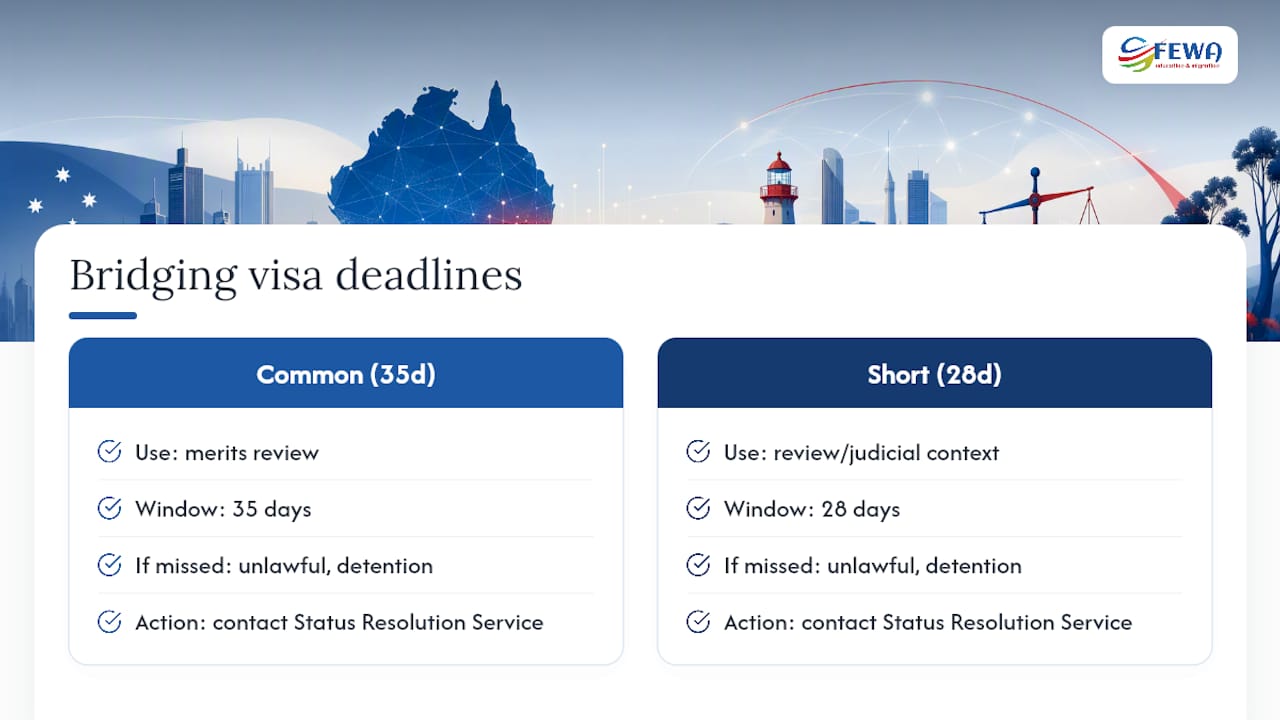
What happens if you miss it: once these windows close without further action, you become unlawful. That can lead to detention, removal, and a debt for the cost of that removal, per Legal Aid Victoria.
If you’re approaching one of these deadlines, contact the Status Resolution Service immediately and get MARA-registered advice before the clock runs out.
Checking your status: VEVO, grant notices and documents to carry
Before you go anywhere, near or far, confirm exactly what your bridging visa allows.
- Log into VEVO and ImmiAccount to check your visa type, expiry, and any work or travel conditions attached.
- Carry a printed or saved copy of your grant notice, your BVB travel window dates (if applicable), your passport, and a VEVO screenshot when travelling.
- If any wording on your grant notice is ambiguous, don’t guess — consider changing your visa status in the UAE without leaving the country if your situation involves cross-border complexities. Contact the department directly or speak with a MARA-registered agent before you act on it.
Behind this guide: Ronit and Fewa’s MARA-backed guidance
This guide is written by Ronit, a consultant at Fewa Education & Migration. Fewa is professionally registered through MARA, the body that regulates registered migration agents in Australia, which underpins the accuracy of the guidance you read here. If your situation involves a refusal, detention risk, or a review application, that’s exactly when a MARA-registered agent earns their fee, complex cases rarely go well on guesswork alone.
What actually trips people up on bridging visas
The mistakes I see repeated most often: travelling on a BVA without realising it isn’t a travel visa, submitting a Form 1005 variation with thin financial evidence, and assuming student work limits don’t apply once a bridging visa activates. Verify before you travel, keep your grant notice within reach, and ask for help earlier than feels necessary.
— Ronit
Get bridging visa help from a MARA-registered team
Professional immigration consultants provide assistance when your bridging visa status, work rights, or travel plans aren’t clear cut. Where a general search leaves you piecing together Home Affairs pages yourself, registered migration agents check your grant notice, VEVO record, and underlying visa conditions directly, then tell you plainly what you can and can’t do.
Our services cover document checks before you travel, full application assistance for BVB and BVC applications, and support if you’re facing a refusal or need a review lodged within the statutory window. We also assist with the substantive visa sitting behind your bridging visa, whether that’s a partner visa, student visa, or skilled migration pathway. Book a free consultation through our visa services page and bring your latest grant notice and VEVO screenshot. That’s the fastest way for us to give you a straight answer, not a guess.
Where to check the official rules yourself
- Home Affairs: Subclass 010 Bridging Visa A for BVA eligibility and cessation rules.
- Home Affairs: Bridging Visa B for travel window conditions.
- Migration Regulations for statutory timeframes.
Rely on these for formal decisions, current fees, and policy changes rather than any secondhand summary.
This article is general information, not a substitute for advice from a qualified lawyer. Consult a qualified legal professional about your own circumstances before acting on anything here.
Sources
- Subclass 010 Bridging visa A (BVA)
- Bridging visa B (BVB)
- Migration Regulations (bridging visa clauses)
- Bridging visas — code and behaviour guidance (Legal Aid Victoria)
FAQ
How long can you stay in Australia on a bridging visa?
There’s no single fixed limit. Your bridging visa generally lasts until your substantive application, review, or court matter is resolved, and if refused, the Migration Regulations typically grant a further 35 days before it lapses.
Who is eligible for a bridging visa in Australia?
You’re generally eligible if you’ve lodged a valid substantive visa application while your current visa is still active, which triggers an automatic BVA, according to Home Affairs. People without a valid visa at the time of applying may instead be granted a BVC or BVE depending on their circumstances.
What is the difference between bridging visa A and B?
A BVA keeps you lawful in Australia but does not allow overseas travel, and leaving the country usually causes it to cease. A BVB adds a specific travel window, a fixed set of dates within which you must depart and return, per Home Affairs.
Does a bridging visa lead to permanent residency?
A bridging visa itself is temporary and doesn’t grant permanent residency. It simply keeps you lawful while your underlying substantive application, which might be a partner, skilled, or student visa pathway, is being decided or reviewed.
Can I work while on a bridging visa?
Your work rights depend on the substantive visa you applied for, not the bridging visa subclass itself. Check the condition codes on your grant notice or through VEVO, and if you need a change, Form 1005 lets you apply to vary those conditions with supporting evidence.